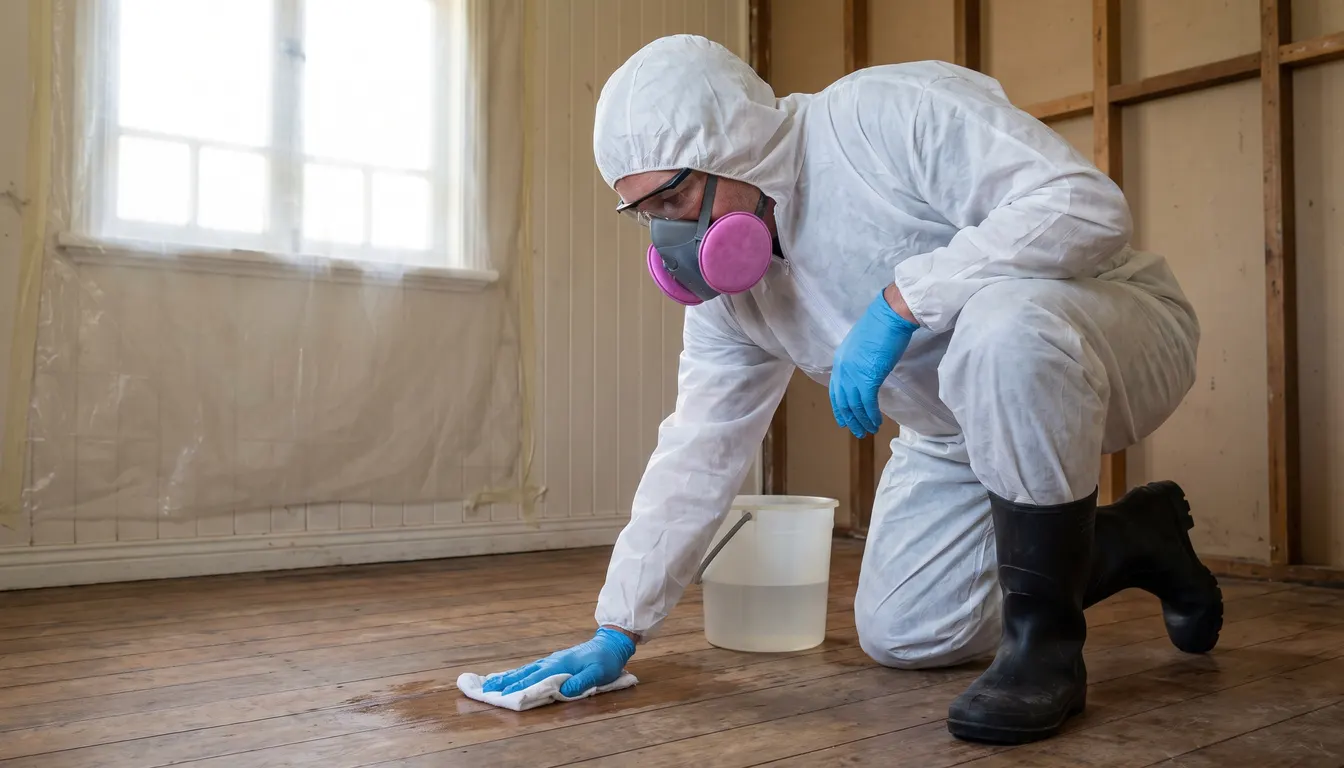
Fire damage
Fire damaged asbestos in Queensland
Fire damaged asbestos in Queensland needs different handling to intact sheeting. Learn what to do first, and why we may refer you to Class A.
Fire damaged asbestos is not the same problem as an old sheet sitting quietly on a wall. Heat changes the material, and the clean-up rules change with it. If your house, shed or garage in Toowoomba has had a fire, read this before you touch anything.
What fire does to asbestos
Asbestos materials can crack or spall when they are heated. Spalling means pieces flake or break off. When that happens, fibres can be released.
The Queensland Government notes that unless the debris is significantly disturbed, the risk to the public and to neighbours is low. That is reassuring, but it does not mean the site is safe to tidy yourself. The risk goes up when debris is moved, swept or walked through.
First steps after a fire
Wait until emergency services say the site is safe to enter. Then:
- Keep people away. Restrict access to the damaged area.
- Keep the debris wet. A gentle spray only. Do not use pressure.
- Do not sweep, vacuum or blast. High pressure water, compressed air and household vacuum cleaners are prohibited for asbestos work, and they spread contamination.
- Wait for a licensed removalist. The guidance is to keep debris wet until a licensed removalist cleans it up.
Why Class A may be needed
Our contractors hold a Class B licence. That covers non-friable (bonded) asbestos, plus dust or debris tied to its removal. It does not cover friable asbestos, or contamination beyond minor dust.
A Class A licence is required for friable asbestos and for asbestos contaminated dust or debris that goes beyond those limits. Fire often creates exactly this situation. Heated sheeting may crack and flake, and debris mixed with ash and char may be hard to separate from the building materials around it.
We do not hold a Class A licence, so we do not take on friable jobs. What we can do is talk it through. Call us on (07) 3185 2323, describe what you can see, and we will tell you plainly whether it sounds like a Class B job or a Class A one.
Other materials that count as friable include sprayed insulation, pipe lagging, the lining of some old heaters and stoves, and the backing on some old sheet vinyl and linoleum. Low density fibre board such as Asbestolux is also treated as friable. If a fire has involved any of these, Class A is the answer.
Who checks the site afterwards
For Class A work, air monitoring is mandatory and must be done by an independent licensed asbestos assessor. A clearance inspection follows, and the result is a written certificate. Neither is done by the removalist. You can read the detail in our guides to asbestos air monitoring and asbestos clearance certificates in Queensland.
Where we can help
Where the damaged material turns out to be non-friable and within our licence, our decontamination and site clean service covers the clean-up, wrapping and disposal. We prepare the safe work method statement, and you receive a clearance certificate when the job is finished.
We would rather tell you straight away if a job is outside our licence than take it on and get it wrong.
Think about the neighbours
If asbestos debris has been thrown across a boundary or sits near the fence line, tell your neighbours. Owners, occupiers and neighbours should be informed before asbestos removal starts. A short, calm conversation is better than a surprise.
Insurance and paperwork
Talk to your insurer early. Ask what they need before work begins, and ask for it in writing. We cannot advise on your policy, but we can tell you what the site needs from a safety point of view.
Health concerns
If you think you were exposed to dust or smoke and you are worried about your health, see your GP. We cannot give medical advice, and there is nothing on this page that replaces a doctor.
Related help
We work across Toowoomba and the region. If your property was also hit by weather, see our guide on storm and hail damaged asbestos in Toowoomba. Rules change, so check the current ones at asbestos.qld.gov.au.
FAQ
Frequently asked questions
Is it safe to go back into a house after a fire if there is asbestos?
Ask the emergency services and your insurer first. If asbestos materials were damaged, keep debris wet and undisturbed until a licensed removalist has dealt with it.
Can I hose down fire debris to clean it?
A light spray to keep it damp is fine. Never use a high pressure cleaner. It is prohibited on asbestos and can spread fibres.
Do you clean up after a fire?
Only where the asbestos is non-friable and within our Class B licence. If the material is friable or heavily contaminated, a Class A removalist is needed. Call us and we will explain.
How do I know if the asbestos has become friable?
You cannot judge it by looking. Do not touch it. Ask a licensed removalist or assessor to look at it.
Get a free asbestos quote in Toowoomba
Call now. We can arrange a site visit to work out the safest way to deal with the asbestos.
More guides
More on asbestos decontamination and site clean
Asbestos Decontamination and Site Clean Toowoomba
Cleaning up and making the area safe after removal.
Learn moreAsbestos Clearance Certificates in Queensland
What a clearance certificate is, and who issues it.
Learn moreStorm and Hail Damaged Asbestos in Toowoomba
What to do when a storm breaks an asbestos roof or fence.
Learn moreWhat to Do If You Disturbed Asbestos
The first steps after you cut, drilled or broke asbestos.
Learn more